
In the dynamic world of business, financial stability can often be elusive. However, one business model has proven to be a game-changer in providing predictable, steady revenue – Recurring Revenue. Whether you’re a budding startup or a multinational corporation like Apple Inc., incorporating a recurring revenue model into your business strategy can drive significant benefits.
Recurring revenue is the portion of a company’s revenue that is predictable, stable, and can be counted on in the future with a high degree of certainty. This revenue model is typically structured on a subscription basis, where customers pay regularly (monthly or yearly) for a product or service.
Monthly and Yearly Recurring Revenue
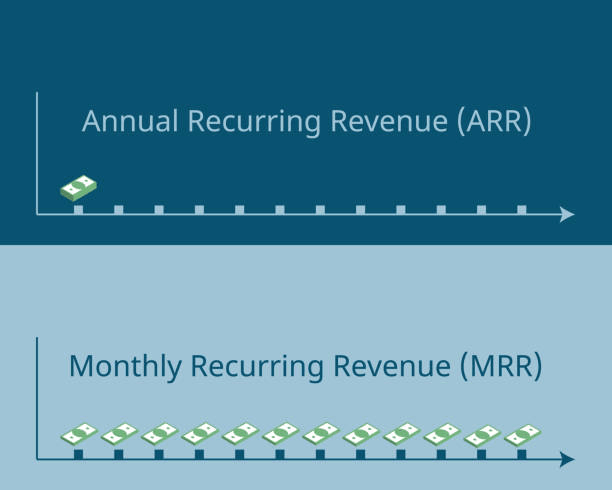
Monthly Recurring Revenue (MRR) and Yearly Recurring Revenue (YRR) are critical metrics for businesses with subscription-based models. MRR is the predictable income a company can expect to receive each month, while YRR is the annual equivalent.
MRR and YRR provide businesses with an accurate forecast of future revenue, enhancing financial stability and aiding in strategic decision-making. They also help businesses identify trends, allowing them to adjust their sales and marketing strategies to optimize growth.
Driving Market Cap with Recurring Revenue
A recurring revenue model isn’t just about financial predictability; it’s also a powerful tool for increasing a company’s market capitalization. By offering a clear projection of future revenues, a company with recurring revenue appears more stable and lucrative to investors. This increased certainty often translates into a higher valuation and market cap, as investors are typically willing to pay a premium for predictable future cash flows.
The ‘Stickiness’ Factor
One of the key goals for a recurring revenue business model is to make it ‘sticky’— that is, to integrate the product or service so deeply into customers’ lives that the thought of cancelling seems unappealing or even detrimental. The ‘stickier’ a product or service is, the higher the customer retention, further enhancing the predictability of revenue.
A classic example of a ‘sticky’ recurring revenue model is seen with software-as-a-service (SaaS) companies like Adobe. By offering indispensable products (like Photoshop or Illustrator) on a subscription basis, Adobe ensures a constant revenue stream while making it hard for customers to switch due to the time, effort, and costs involved in learning and migrating to a new system.
Apple Inc., with its suite of services like iCloud, Apple Music, and Apple TV+, has also succeeded in creating a ‘sticky’ ecosystem. The convenience and seamless integration of Apple’s services make it costly, both in terms of time and effort, for users to switch to an alternative.
In Conclusion
The recurring revenue model has changed the business landscape, providing companies with a pathway to financial predictability and growth. By offering ‘sticky’ products or services that customers value and depend on, businesses can reduce customer churn and secure a stable, recurring revenue stream.
In a world where businesses are increasingly judged by their predictability and growth prospects, adopting a recurring revenue model could be the key to success. By intertwining your services into the fabric of your customers’ lives, your business not only secures its future revenue but also cements its position in the market, driving growth and market valuation.
 Financial Freedom 101
Leave a comment