
Effective goal-setting is a crucial skill that many companies, and individuals alike, struggle to master. Yet, some of the world’s leading tech giants like Google, Amazon, and Microsoft seem to have cracked the code. The secret? A goal-setting framework known as Objectives and Key Results (OKRs), originally introduced in 1983 by Andy Grove, the former CEO of Intel.
OKRs gained momentum in 1999 when John Doerr, who worked for Andy Grove, presented the framework to Google founders Larry Page and Sergey Brin. Since then, OKRs have been a guiding principle for many of the world’s most successful companies. Google’s Larry Page even credits them for Google’s explosive growth, keeping the company on time and on track during crucial periods.
So what makes OKRs such a powerful tool?
Understanding OKRs
In simple terms, OKRs provide a structure that helps bridge the gap between strategy and execution by answering three primary questions: What do you want to achieve? How will you know when you’ve achieved it? How are you going to achieve it?
These three questions correspond to the three components of OKRs:
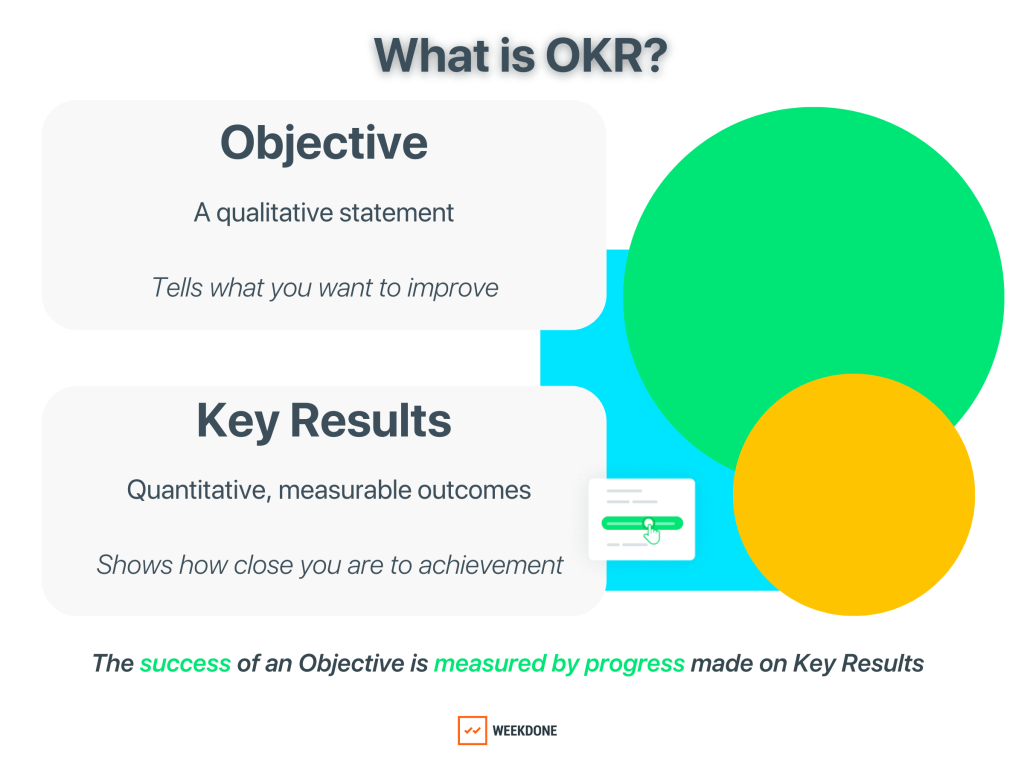
- Objective: This is the overarching goal you’re aiming to achieve. It sets the direction and articulates the ‘What’ part of the equation. This is often the strategic aspect of your goal.
- Key Results: These are the measurable benchmarks that indicate whether you’ve achieved your objective. They define the ‘How will you know’ aspect by providing quantifiable targets. This can be viewed as the measurement component.
- Initiatives: These are the specific tasks or actions that you’ll take to achieve your key results. They answer the ‘How are you going to achieve it’ part and relate to the execution element.
Applying OKRs
To further clarify, let’s consider a couple of examples. In a business context, if your objective is to ‘Improve the company website,’ your key results could include ‘Re-design visuals and layout of the website’ and ‘Increase visit times by 10%.’ Your initiatives could then be ‘Write a design brief and hire a freelance designer’ and ‘Add 10 videos from the content library to the website.’
On a personal level, if your objective is to ‘Improve fitness & physical health,’ your key results could be ‘Lose 3kgs in 90 days’ and ‘Be able to do 50 push-ups in a row.’ The initiatives to achieve this might be ‘Start a meal plan subscription that limits calories’ and ‘Find an accountability partner and do 20 push-ups per day.’
Why OKRs?
The beauty of OKRs lies in their simplicity and clarity. They eliminate ambiguity and ensure everyone involved has a clear understanding of what needs to be achieved, what success looks like, and how to get there.
Many goal-setting frameworks fall short because they fail to bridge the gap between strategy and execution. They set lofty objectives without defining what success looks like and how to achieve it. OKRs fill this gap by providing a clear and measurable path to achieving your goals.
Whether you’re setting goals for your personal life or your business, consider adopting the OKR framework. It will provide a robust and proven structure to guide your efforts and increase your chances of success. Remember, an effective OKR should express: “I will (Objective) as measured by (this set of Key Results) by doing (these Initiatives).” By doing so, you leave no room for confusion, only a clear path towards your objectives.
 Financial Freedom 101
Leave a comment